1. Jan. 14: Rock and Roll + Rockabilly + Girl Groups
The Beatles: “Help,” Recorded London (EMI Studios), April 1965
https://www.youtube.com/watch?v=2Q_ZzBGPdqE
Help I need somebody
(Help) not just anybody
(Help) you know I need someone
(Help)
When I was younger so much younger than today
I never needed anybody’s help in any way
But now these days are gone I’m not so self-assured
Now I find I’ve changed my mind and opened up the doors
Help me if you can, I’m feeling down
And I do appreciate your being ’round
Help me get my feet back on the ground
Won’t you please, please, help me?
And now my life has changed in oh so many ways
My independence seems to vanish in the haze
But every now and then I feel so insecure
I know that I just need you like I’ve never done before
Help me if you can, etc.
When I was younger, etc.
Help me if you can, etc.
Like the word “jazz,” the words “rock” and “roll” referred in African American lyrics, and presumably speech, to sexual activity probably since before the advent of recorded sound.
Alan Freed: “Moondog’s Rock’n’Roll Party” began June 1951, WJW Cleveland.
Radio Luxembourg: introduced British listeners to rock and roll when it was effectively banned from the BBC.
Little Richard: “Tutti Frutti,” composed by Richard Penniman (“Little Richard”) with additional lyrics by Dorothy LaBostrie. Recorded New Orleans, 1955.
https://www.youtube.com/watch?v=F13JNjpNW6c
Possibly the greatest rock and roll song, and if not, then certainly definitive. Banned in Little Richard’s home state of Georgia for its suggestiveness–and this was after the lyrics were cleaned up by LaBostrie. Original: “Tutti Frutti good booty.” Cleaned up: “Tootie Frutti aw rootie.” The backing band is outstanding, and Richard’s piano is highly skilled and surprisingly subtle–especially considering that there was no overdubbing of vocals in the ‘50s, and he was playing piano and singing simulataneously. The term “rock and roll” had been current for at least a decade, but this song gives and early example of the “back beat” (strong accent on the 2nd and 4th beat of a 4/4 measure) that Chuck Berry praised in “Rock and Roll Music” (1957). Little Richard claimed his life long to have taught Paul McCartney the falsetto “whoo.” Of course the Beatles could have learned this vocal technique from Richard’s records. However, the claim is not implausible. Certainly sharing the stage–and dressing rooms–in Hamburg with Little Richard several times must have been an instructive experience.
Jackie Brenston and The Delta Cats: “Rocket 88,” recorded 1951 Memphis at Sam Phillips studio, later called Sun Studio.
https://www.youtube.com/watch?v=WcFIj8OuIEI
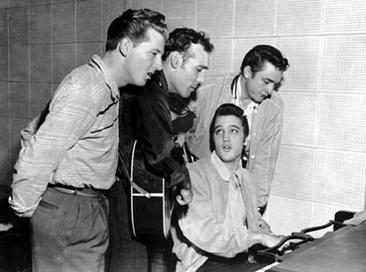
The Delta Cats were in fact The Kings of Rhythm, the backup band of Ike Turner, who arranged the music. The rhythm here is closer to swing (“dit dit da-dit dit da-dit dit da-dit”) than it is to the fully developed back beat later characteristic of rock and roll, such as “Tutti Frutti.” Sam Phillips of Memphis is one of the heroes of American culture, and his Sun Studio one of the sacred sites. Phillips fostered African American talent including B. B. King, Howlin’ Wolf, and Rufus Thomas. He barely broke even until he recorded blues-flavored material with the likes of Jerry Lee Lewis, Carl Perkins, and Elvis Presley. Here’s a famous photo of the “million-dollar quartet,” with the addition of Johnny Cash:
Carl Perkins: “Blue Suede Shoes,” recorded Dec., 1955, at Sun Studio Memphis (released Jan. 1, 1956)
https://www.youtube.com/watch?v=TRkethWqor8
George Harrison worshipped Carl Perkins so much that he adopted, briefly in 1960, the stage name “Carl Harrison.” This track contains the innovation of two guitar players, one strumming chords (“rhythm guitar”), the other (Perkins himself) alternating single or double note accents (“lead guitar”) with the vocal. The “slap bass,” an “upright” or “doghouse” bass (not an electric), emphasizes the back beat. John Lennon introduces himself in Help as “rhythm guitar & mouth organ.” The instrumentation of “Help” is identical with that of “Blue Suede Shoes” with Lennon on acoustic rhythm guitar. This song represents a turning point in rock and roll away from the big-band sound of earlier rhythm and blues. Later, the term “rockabilly” was applied to this musical manner, with roots in both R&B and country and western. Just goes to show that these stylistic distinctions are really just marketing demographics, and not particularly admirable ones at that, with their cultural redlining. Sam Phillips and the Sun label offer relatively rare examples of multiracial production and marketing.
Buddy Holly: “Oh Boy!” recorded 1957 in Clovis, New Mexico
https://www.youtube.com/watch?v=25e1k7sTpSo
Buddy Holly was the third member of The Beatles’ blessed trinity along with Little Richard and Carl Perkins. (Chuck Berry was also huge.) Holly was a particularly encouraging role model for the young, bespectacled John Lennon. And with their modest instrumentation–just electric guitar, upright bass, and drums–Holly’s band offered a realizable rock and roll alternative to more horn-oriented rhythm and blues. The name of Holly’s band, The Crickets, was calculated to situate them as a vocal group, even though they did not provide backing vocals on most of their early hits. Lennon took the insect motif and aimed it toward the (back) beat with Long John and the Silver Beetles–soon changing the spelling to emphasize the play on words.
Bill Justis: “Raunchy,” recorded 1957 at Sun Studio, Memphis, composed by Justis and Manker.
https://www.youtube.com/watch?v=A8a0KgxWQzQ
This instrumental 12-bar blues shows strong country and western affinities–the first saxophone part sounds almost fiddle-like. The “twangy” guitar sound strongly influenced Duane Eddy, Link Wray, and George Harrison. We hear it strongly in the chorus of “Help.” The 15 year-old Harrison used this song to audition for The Quarrymen, later The Beatles, overcoming the resistance of Lennon and McCartney to his youth.
The Ronettes: “Be My Baby,” recorded 1963 in Hollywood
https://www.youtube.com/watch?v=jSPpbOGnFgk
The Beatles learned a lot about vocal harmony from the “girl groups” of the 50s and early 60s, especially The Marvelettes, The Shirelles, and The Vandellas. “Be My Baby” is particularly significant as a classic example of producer Phil Spector’s “wall of sound.” So great was Spector’s influence that The Beatles brought him in late in their career together to finalize the production of the “Let It Be”/”Get Back” sessions. After The Beatles broke up, Spector produced George Harrison’s first solo album, the massive triple album All Things Must Pass.
“Help” on the Ed Sullivan Show, Sept. 1965.
https://www.youtube.com/watch?v=ADrsVo5RCG8
George plays a simplified guitar guitar part in the transition from the intro/chorus to the verse. Ringo plays entirely on the rim of the snare giving the drum sound unusual punch. His unison 16 notes on snare and tom on the transition from the verse to the chorus is extremely creative and effective.
Extra Listening:
Big Mama Thornton: “Hound Dog Blues“
https://www.youtube.com/watch?v=yoHDrzw-RPg
Chuck Berry: “Rock and Roll Music”
https://www.youtube.com/watch?v=2wOZbMjzJsQ
Gene Vincent and The Blue Caps: “Be Bop a Lula”
https://www.youtube.com/watch?v=KDCSG97anKU
Little Eva: “The Loco-Motion“
https://www.youtube.com/watch?v=JSVw-JHuCnk
 DK's Poems