Technical Stuff
July 10, 20
I claim that Rendered into Song is my first solo album, but that’s true only in a certain sense. Earlier, in 2025, I recorded over three hours of backing music for Of Real Things. But Rendered is what I would call a real album, consisting of songs with sung words. Nevertheless, the relation of the two works is close, for what I’m rendering in Rendered into Song are motifs from Of Real Things–hence the subtitle “Being Variations on Themes from Of Real Things.” The substance of those themes and variations must wait for a later post. In this post I will touch upon the technological aspects of both works (I guess) and especially upon my learning curve with digital audio and especially with digital sound sources.
I started recording in my basement, where my rock band rehearsed, in the second half of the 2000s. Early on I gravitated toward a digital audio workstation (DAW: recording software) called Reaper. I love Reaper and use it to this day. It’s a tenth of the price of some of the premium DAWs, but very fully featured. While I have invested over the years in some third-party “plugins,” the ones I use most are Reaper effects: eq, compression, and delay. (I direct these remarks to those unfamiliar with the technical aspects of recording; you don’t have to know what eq, etc., are.) As I suggested above, the learning curve with digital audio is both steep and endless. Accordingly, I wish I had discovered earlier than I did the excellent instructional videos by Kenny Gioia. If I had, I would have had an easier time recording DK & The Hoop Snakes for over a decade. As it was, I discovered more or less on my own how to record, to mic instruments, and to get their sounds on the hard drive. More importantly, and this was the really steep curve, how to mix audio, how to use those plugins to make the recorded material sound good. You know, it may sound good in the room, but when you play it back it just doesn’t sound so good, unbalanced and muddy.
The steepest stretch of this aspect, the miking and mixing, was getting a drum sound. Here I must give thanks and praise to my co-producer in those days, Lord Accurate (the bass player Charles Barrow). He turned me on to the Glyn Johns three-mic technique for drums, which we expanded through much trial and error to about six mics. Lord Accurate also brought vital knowledge as to using certain plugins to give the kick drum punch and make the snare sound otherwise than like an oatmeal box. (In the studio, for reasons I won’t bore you with, we call the bass drum a kick drum, or just kick.) This knowledge proved invaluable when I switched from live drums to drums in a digital sound source.
The world of digital sound sources is kind of mind boggling. When DKHS broke up, I purchased the Steven Slate Drum Sampler. I don’t know how they do it, but SSD comprises an immense collection of recorded individual strokes by real drummers on real drums. It’s organized as dozens of drum kits (sets). Within any kit you can choose, for example, from among maybe half a dozen snare strokes, such as striking the center of the snare or striking the snare so as also to hit the rim. Then of course there’s kick, several cymbals (with varying strokes), and between two and four tom toms. So I select a kit, now I have to do something with it. Now I must digress on the subject of midi.
MIDI = Musical Instrument Digital Interface. It allows a musical keyboard (not qwerty, although you could use that too) to talk to a computer. But here’s the deal: you have to have a sound source. When the keyboard talks to the computer, you’re not hearing the keyboard you’re hearing something that has been loaded into the computer. There used to be something called General Midi which comprised, to my ear, some pretty godawful synthesized trumpet, flute, and piano sounds. This turned me off midi for years, although I did use midi–sparingly–with The Snakes. I didn’t know that there were, for a price, much better sound sources than General Midi. Hence Steven Slate Drums and some other sound sources I’ll talk about shortly.
Discovering sound sources was a big step, but I also had to learn about recording midi. With The Snakes I sometimes used midi as an interface using single-sound sources I found, but I always recorded to audio, not to midi files. An audio file is a waveform like the soundtrack of a film, the vibrations that you hear:

A midi file looks like the perforations on a player-piano roll or the prongs that strike the comb in a music box. It’s certainly possible to edit an audio file, to cut and paste and so forth–that’s one of the major functions of a digital audio workstation. But it’s a bit like using Photoshop to edit a picture. Editing midi is more like word processing. It’s easy (once you get the hang of it) to cut, paste, move things around, and adjust things like note length. And you’re not locked in to a particular sound. Depending on your sound source, you can choose a trumpet for a bassoon or choose from an infinite variety of synth sounds or drum kits.
Now, Steven Slate drums comes with a bunch of built in beats. There are also a jillion beats available for download from various quarters. I want you you to know now that I made, rather laboriously using the midi editor, every beat on both Of Real Things and Rendered into Song. I can’t play the drums, but I’ve played with drummers since I was 13. With Real, at the bottom of the curve, I had my hands full just creating beats, which I basically looped. With Rendered, I’ve learned to vary the loops, and more importantly, to add the embellishing fills that give drummers their style.
For melodic sounds, I used a collection of freely available software synthesizers including Surge, Tyrell, Vital, and Odin II. When I was looking for free softsynths I happened upon a post by the great teacher Kenny Gioia at the Reaper forum asking for suggestions. One response mentioned BBC Orchestra, freely available from Spitfire (now Splice), not a synth emulator like the others I mentioned, but a sampled sound source like Steven Slate. My mind was officially blown–here were recorded samples of single notes played by members of the BBC orchestra on real instruments for no charge. So when you hear on ORT or RiS an oboe or string section or grand piano, you’re hearing notes played by the BBC orchestra. O brave new world! Do let me disclaim that the great sounds come from a sound source, but I invented the melodies and the harmonies, coaxed them out of my midi keyboard, edited the resultant midi files, and mixed them with many other tracks in Reaper.
One of the main sound sources I use, which I admit to having paid for, is Analog Lab. This product, from Arturia, a French leader in the high-end hardware synthesizer market, is crazy compendious, offering hundreds of keyboard, bass, organ, piano, and other sounds. One sound that I use with a symbolic significance throughout Real and Rendered is Astral Voices–a female voice that moves slowly through various vowel sounds. I say symbolic significance–she is the “Mother before nature” in Of Real Things and a similarly admonishing and redemptive figure in Rendered into Song. I’ll talk about her more when I touch upon leitmotifs and their variation, soon, I hope.
Another sound from Analog Lab that I use on almost every song on Rendered is Deep Pluck: a double bass played pizzicato, as in jazz, with a little echoey delay built in. I usually layer Deep Pluck with some other bass sound or sounds from from Analog Lab or from one or more of my software synths. On the opening of “A Tragic View of Life” I use Deep Pluck with a real bass, a Fender Jazz.
I would be remiss if I did not mention the two most important sound sources, the electric guitar and the human voice. I’m ashamed to confess that for reasons unknown to me I did not use in any of the many guitar parts on Of Real Things my excellent guitar amplifier, a 1994 Mesa Boogie Dual Calibre, handmade (like all Mesas) in Petaluma, California. I guess I was so intoxicated by non-live drums and whatnot that I tried to use software amplifiers, which sounded shrill and kind of horrible. But on Rendered into Song, I got some of the best guitar sounds out of my Mesa ever. One of the nice things about that amp is that it has a “pre-amp out.” Without getting too technical, the sound of a guitar amp comes from its preamp and its small vacuum tubes, not the amplifier with its big tubes that power the speakers. So: no speaker sound, just the tone-y pre-amp direct to the board. I use three electric guitars for three different purposes. I have a Chinese copy of a Telecaster, into which I have installed American made pickups. I use this for funky, clean rhythm guitar sounds. I have a Chinese copy (sort of) of a Fender Jaguar, into which I have installed an American P90. Too technical, I know, but a P90 is a powerful single-coil pickup. I use this guitar for crunchy, hard-rock guitar sounds. Then there’s my beloved made-in-Korea mid-90s Epiphone Les Paul. This was a gift decades ago from my dear sister-in-law, Catherine. I play neither fast nor particularly cleanly, but my lead guitar sings, and my Les Paul contributes mightily to that achievement.
Just as the electric guitar produces many moods and sounds on Rendered, so too does my voice. Most of the time I sound like the 70-some-odd-year-old that I am. However, even in my voice’s younger days I used, and still do, various studio tricks to get various unnatural sounds (not to disguise my gravelly age). Sometimes this is straight-up sound mangling, as in “Rough brutal beast” on “Free Your Hand” or “I prayed for madness and the madness came” on the album’s title track. A technique I learned from George Martin is to record a vocal part with the instrumental tracks slowed down slightly. Playing back at normal speed raises the vocal pitch and gives it a lighter, more youthful timbre. I did this to the extreme in the same song (“Rendered”) when I have a child sing “Give us our nourishment.” (I learned the gimmick of the child voice from Aphex Twin’s “naughty little boy.”) I used the opposite technique–speeding up the instrumental track–on “This is Hell” to make the voice sound old, exhausted, and otherworldly.
In two songs a voice much better than mine appears, that of my daughter Lydia Sharp, who happens, among other accomplishments, to sing first soprano for The Atlanta Symphony Orchestra Chorus. Lydia also has a degree in music theory. You can hear hear on two of the verses in “Empire (The Tyger).” She also–times 6–sings the word agoraphobia in “Agoraphobia.” I owe her a great debt, not only for her vocal contributions but especially for helping me develop such skill as I possess in voice leading, the art of devising harmonies.
Leitmotif: The Goatboy Theme
July 12, 2026
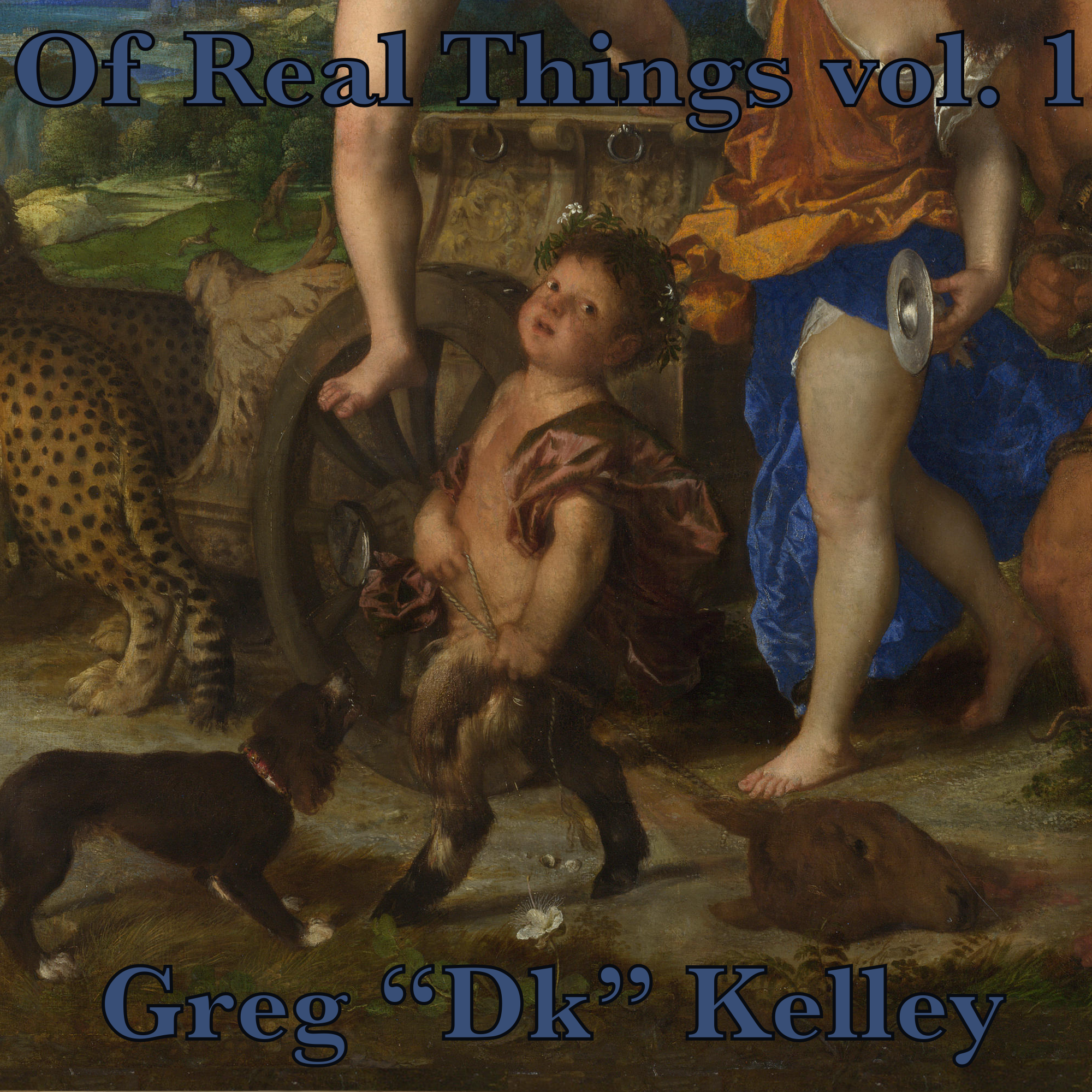
One of the stylistic features of Of Real Things is its use of musical leitmotifs [https://en.wikipedia.org/wiki/Leitmotif]. The technique of using musical phrases to signal a character or thematic element is associated with the “music dramas” of Richard Wagner but appears prominently in film scores, notably those of Ennio Morricone and John Williams. One of the most important leitmotifs in Of Real Things is the one I call the Goatboy theme, and it’s even more prominent in Rendered into Song. Preparatory to anything further, let me request that you invest 30 minutes or so reading/listening to chapters 5 [https://dkpoems.com/of-real-things/#of-real-things-5-an-ode-on-bacchanalia] and 20 [https://dkpoems.com/of-real-things/#of-real-things-20-fallen-and-again-fallen] of Of Real Things. The Goatboy theme and several of the other leitmotifs appear in those sections rather distinctly.
Chapter 5 gives a point-by=point description of Titian’s great painting, Bacchus and Ariadne [https://www.nationalgallery.org.uk/paintings/titian-bacchus-and-ariadne]. The cover art for Of Real Things, and the conclusion of chapter 5 focus on a single detail, a faunlet or child-satyr, his head thrown back, gazing at the viewer. He’s barked at by a dog, and he drags with rope the head of a doe.
A little boy his hair entwined with tiny white flowers
Toward whom a flopped-eared dog barks
In hunger hostility or invitation to play
Near the child’s hooves and goat-haired legs
Whose small cloak echoes that great of the god
And how child did you wind up among the divine retinue
And does your mother number among the maenads here
Who nourished your chubby arms chubby cheeks
And the child drags with rope
The severed head of a beast
Nor horn nor antler
Perhaps the victim
That rendered up the haunch
He wears a facial expression that bespeaks–what? Defiance? Privilege? Bewilderment? I gravitate toward the last of these:
And he gazes at us
Of substance mixed
Goat and boy
Unsettling and unsettled
Lips parted
What is this overmuch of variegated world
It’s hard to talk about leitmotifs because they always appear in conjunction with a character or theme: your response to the musical element is influenced by your response to the thematic element.
Here is the Goatboy theme in its purest form.
It’s played on a group of oboes, famous for their plaintive tone, but also characteristic of the Bacchic (or Bacchanalian) element in ancient, really ancient, Greece. The main element is a three note figure: a tone, a half step down, and the tone again. That downward half step is Wagner’s “woe” motif. But the return to the first note suggests equilibrium. Around this repeated three-note figure pivot several other notes: one below, another below that, a return to the “below” note, and a note above. That’s what you hear in chapter 5. But the clip above comes from “Animals Think,” the second song on Rendered. The instance of Goatboy here adds two more, rather triumphant notes to conclude the motif. Chapter 5 of Real withholds the triumph until the very end, when guitar chords supply the last two notes. The coda of “Animals Think” is most triumphant, as Bill and Ted would say. But like chapter 5, triumph is held back until the end. An early instance of the Goatboy theme is intoned by slide guitars during the instrumental interlude at 2:27 and a minute later in three-part harmony. The chorus of Animals think (“I wonder what . . .”) becomes its own motif and forms the ending, without vocals, of the title track, “Rendered into Song.”
A more elaborate development of the Goatboy theme forms the basis of the album’s thematic heart, “Free Your Hand.” The chorus, with a rising melody, offers the optimistic suggestion that freeing your hand, and thus your mind, is at least possible in this overmuch of variegated world. But the verse, where the Goatboy theme appears, is tinged with sadness: “Can’t stop the rain can’t raise the dead.” But, “you can see the children fed.” This is a major theme in Rendered into Song: “give us our nourishment,” in the title track. When we become self-absorbed, focussing on our own problems, “this is hell.” But
Three bags of groceries need you ask
The kids [e.g., the Goatboy] must grow and grow so fast
But head and heart don’t multitask
So free your hand of selfishness and your mind of self-absorption. Take care of others, especially the vulnerable ones like children.
The Goatboy theme makes briefer but still prominent appearances elsewhere in the album, for example, in the guitar solos of “A Tragic View of Life” and “Rendered into Song” and in the instrumental interludes of “Thanks But No Thanks” and “More Quietly.”
On some occasions the Goatboy theme reaches its triumphant conclusion. Sometimes in remains unresolved. More often, perhaps, it leads into tragedy, which is its home: “everybody sorrows and every beauty dies.” This brings us the the Empire theme, which itself ranges from the tormented to the redemptive.

